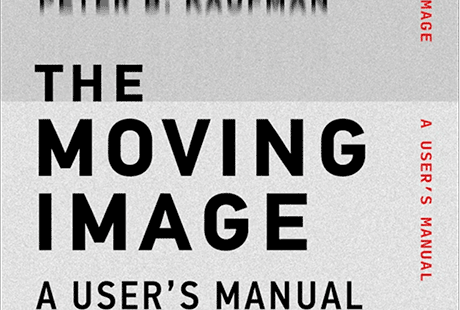
Video (television, film, the moving image generally) is today’s most popular information medium. Two-thirds of the world’s internet traffic is video. Americans get their news and information more often from screens and speakers than through any other means. The Moving Image is the first authoritative account of how we have arrived here, together with the first definitive manual to help writers, educators, and publishers use video more effectively.
Drawing on decades as an educator, publisher, and producer, MIT’s Peter Kaufman presents new tools, best practices, and community resources for integrating film and sound into media that matters. Kaufman describes video’s vital role in politics.law, education, and entertainment today, only 130 years since the birth of film. He explains how it’s the moving image—not social media, not artificial intelligence, but television networks and online video—that has played such an outsized role in bringing personalities like Trump, Putin, Xi, Modi, and Netanyahu to the front of the world stage and deepening what journalist Hanna Rosin calls our “epistemic chasm of cuckoo.”
Kaufman also explains how best to produce video, distribute it, clear rights to it, cite it, and, ultimately, archive and preserve it. With detailed guidance on producing and deploying video and sound for publication, finding and using archival video and sound, securing rights and permissions, developing distribution strategies, and addressing questions about citation, preservation, and storage—across the broadest spectrum of platforms, publications, disciplines, and formats—The Moving Image equips readers for the medium’s continued ascendance in education, publishing, and knowledge dissemination in the decades to come. And modeled in part on Strunk and White’s classic, The Elements of Style, it’s also a highly enjoyable read.
Reviews
“Indispensable. A groundbreaking guide to navigating video as today’s dominant medium.”
Allissa V. Richardson, author of Bearing Witness While Black
“A work of genius. The book tells us how to preserve, protect, and curate the moving image as an integral part of fighting back against our current epistemic implosion.”
Lee McIntyre, author of On Disinformation
“This visionary work is an essential, authoritative, and entertaining companion for makers, authors, and scholars that will help them produce, deploy, and quote moving images with fluency and integrity.”
Rick Prelinger, archivist and Emeritus Professor, University of California, Santa Cruz
“At a time when video has become the dominant medium of communication, Kaufman provides a much-needed primer for scholars and practitioners alike.”
Sandra Ristovska, author of Seeing Human Rights
Events with the Author
Thursday, February 27
Museum of the Moving Image – New York
With Aziz Isham, Executive Director, Museum of the Moving Image
https://movingimage.org/event/the-moving-image-a-users-manual/
Tuesday, March 4
Cambridge Forum – Cambridge, Massachusetts
With NYU professor and author Robert Boynton, Arthur L. Carter Journalism Institute
https://cambridgeforum.org/the-moving-image-a-force-to-be-reckoned-with/
video: https://www.wgbh.org/forum-network/lectures/the-moving-image-a-force-to-be-reckoned-with
Thursday, March 6
New York Public Library – New York
With WNYC Archive Director Marco Suiero Bal
video: https://youtu.be/pKn3kjt_CLc
Wednesday, March 12
Book Culture – New York
With Columbia University School of Journalism producer and director Ben Shapiro
https://www.bookculture.com/event/112th-peter-kaufman-ben-shapiro
Tuesday, March 18
Internet Archive – San Francisco (with the Booksmith)
With Rick Prelinger, archivist, filmmaker, and professor emerit, UC Santa Cruz
https://blog.archive.org/event/book-talk-the-moving-image-with-peter-b-kaufman-and-rick-prelinger/
video: https://archive.org/details/book-talk-the-moving-image-with-peter-b-kaufman-and-rick-prelinger-3
Thursday, March 20
Half Moon Bay Brewing Co. (with Ink Spell Books)
With Lenny Mendonca
https://www.hmbbrewingco.com/events-calendar/the-moving-image
Thursday, March 27
Harvard University Berkman Klein Center (with the Harvard Coop)
With Harvard Law School professor and Berkman Klein founder Charles Nesson
https://brk.mn/movingimagetalk
Tuesday, April 8
Coalition for Networked Information – Spring 2025 Membership Meeting – Milwaukee
With David Rowntree, University of Hawaii, and Brewster Kahle, Internet Archive
https://www.cni.org/topics/ci/safeguarding-audiovisual-data
video: https://www.cni.org/topics/ci/safeguarding-audiovisual-data
podcast (video): https://er.educause.edu/podcasts/the-cni-interviews-podcast/2025/access-and-preservation-in-the-audiovisual-age
Tuesday, April 8
Chicago Filmmakers (with the Seminary Coop)
With Charles Coleman, FACETS
Sunday, April 27
Scoville Library – Salisbury, Connecticut (with Oblong Books)
With YIVO Executive Director and CEO Jonathan Brent
https://scovillelibrary.libcal.com/event/13902300
Saturday, May 24
ZoomerPlex – Toronto, Canada
With Moses Znaimer, Marc Glassman, Ed Conroy, Brian Johnson, and Anthony Wilson-Smith
https://youtu.be/Jh3VwlIatGw?si=qCPojTc9qAZRzEXt